









 Counseling & Strategic Advice
 IP Transactions
 Litigation
 PTAB Proceedings
 Technology Transfer
 Trademark & Designs
 U.S. Patent Procurement (Application Drafting & Prosecution)








MARCH 2026 - IP UPDATES
.png)
USPTO UPDATE
USPTO Updates Guidance for More Flexible Examination of Design Patent Applications Related to Computer-Generated Interfaces and Icons
BY COLIN HARRIS
On March 13, 2026, the United States Patent and Trademark Office (USPTO) issued supplemental guidance that provides design patent applicants with greater flexibility when claiming computer-generated interfaces and icons. Published in the Federal Register on March 13, 2026 (Docket No. PTO-P-2026-0133), the guidance revises prior examination practices under 35 U.S.C. § 171 and will be incorporated into the Manual of Patent Examining Procedure (MPEP) in due course. We last reported on this topic on February 6, 2024.
Background
In December 2020, the USPTO issued a Request for Information regarding the “article of manufacture” requirement and its application to emerging technologies such as projections, holograms, and virtual/augmented reality (PHVAR) designs. The USPTO issued Supplemental Guidance in 2023 and 2024 addressed design patent protection for computer-generated electronic images but retained certain drawing and claim-language restrictions. Following additional stakeholder feedback, the USPTO has now issued this updated guidance in an effort to modernize its approach and align with technological advancements.
Key Changes
The recently issued supplemental guidance introduces the following primary updates:
1. Elimination of the Broken-Line Display Panel Requirement – The USPTO has removed the prior instruction in MPEP § 1504.01(a) that required drawings to depict a computer display panel or portion thereof in solid or broken lines. When both the title and claim properly identify an article of manufacture (e.g., a computer, computer display, or computer system), the design claim will satisfy the article of manufacture requirement under 35 U.S.C. § 171 without the need for such a depiction. Applicants may still elect to include broken-line display regions if desired.
2. Acceptance of “For” Language in Titles and Claims – Claim and title language using the preposition “for” is now expressly accepted. Examples include “icon for a computer display screen,” “projected interface for a computer,” “graphical user interface for a computer system,” or simply “computer icon.” Examiners will no longer object to such phrasing under 37 CFR § 1.153 (or 37 CFR § 1.1067 for international design applications). The guidance clarifies that the term “for” sufficiently ties the design to an article of manufacture and distinguishes it from a mere transient or disembodied image.
3. Expanded Eligibility for PHVAR and Other Emerging Designs – The guidance confirms that computer-generated interfaces and icons, including projections, holograms, virtual reality, and augmented reality designs, are eligible for protection when claimed as being “for” a computer, computer display, or computer system and when the appearance is more than a transient or disembodied picture. This expands upon the 2023 guidance and draws on precedents such as In re Hruby, 373 F.2d 997 (Cust. Ct. 1967) and the Supreme Court’s broad interpretation of “article of manufacture” in Samsung Electronics Co. v. Apple Inc., 580 U.S. 53 (2016).
The supplemental guidance emphasizes that the complete disclosure (title, claim, specification, and drawings) must still satisfy all other patentability requirements, including 35 U.S.C. §§ 102, 103, and 112, as well as the formal drawing rules under 37 CFR § 1.152.
The guidance provides twelve detailed examples (Examples 1–4 and 6–10 comply with § 171; Examples 5, 11, and 12 do not) that include a title, description, and claim to help practitioners see how this guidance will be implemented by examiners. The provided examples range from traditional GUI icons shown with optional broken-line displays to projected keyboards, holographic interfaces, and virtual reality designs claimed for a computer or computer system. The examples illustrate acceptable claim and title language as well as situations where the absence of any article-of-manufacture reference results in rejection.
Effective Date and Next Steps
This supplemental guidance is effective immediately and applies to all design patent applications and proceedings filed before, on, or after March 13, 2026. It does not constitute substantive rulemaking and does not create any enforceable rights. Any written comments must be received by May 12, 2026, via regulations.gov (Docket PTO-P-2026-0133).
Applicants and practitioners should review pending applications to determine whether amendments to titles, claims, or drawings can take advantage of the new flexibility. The USPTO has indicated that additional examiner training materials will be provided.
CAFC UPDATE
Federal Circuit Refuses to Construe "Configured For" as More Than "Capable Of"
BY YAN CONG, PhD
In In re Blue Buffalo Enterprises, Inc., No. 2024-1611 (Fed. Cir. Jan. 14, 2026), the Federal Circuit affirmed the PTAB’s decision affirming the Examiner’s obviousness rejection after rejecting Blue Buffalo’s narrow construction of the claim term “configured for”.
The Examiner, giving “configured to” its broadest reasonable interpretation, interpreted the term as an intended use of the claimed spaced projections. Therefore, the Examiner considered prior art disclosure of a similar structure “capable of” performing this use as meeting this claim limitation.
On Appeal, among other things, Appellant argued that “configured to” was more than an intended use, requiring mere compatibility. The PTAB disagreed and affirmed the Examiner’s rejection.
Blue Buffalo appealed to the Federal Circuit, relying on In re Giannelli, 739 F.3d 1375 (Fed. Cir. 2014) and Aspex Eyewear, Inc. v. Marchon Eyewear, Inc., 672 F.3d 1335 (Fed. Cir. 2012) for the proposition that “configured to” should be construed as “specifically designed to”.
The Court distinguished Aspex Eyewear and Giannelli, finding no basis in the claims or written description that “configured to” should be construed to require more than a structure “capable of” removing the product from the storage area and using the projection to break up and/or tenderize the food. Based on this construction, the Court affirmed the Board, finding the claims obvious over Coleman.
The Court’s decision provides a useful caution on the limits of “configured for”, “configured to”, and similar terms to impart structure to a product claim to distinguish from prior art products. Such terms, which have functional characteristics, present an inherent tension between the Applicant’s desire to avoid potentially unknown prior art while preserving a broad construction in a later prosecution and/or litigation. If the Applicant is forced to rely on narrowing prosecution arguments to avoid prior art during prosecution, this can introduce ambiguity into the claim construction applied by a court in a later litigation. One way to try to avoid this outcome is to include several alternative embodiments in the specification that may be turned to for supporting prosecution amendments that narrow the claims just enough to avoid cited art while maximizing the potential for the broadest possible claim construction. Another option for encouraging a narrower construction is including a similar claim reciting “capable of” or similar language, allowing the Applicant or patentee to rely on the doctrine of claim differentiation to encourage a narrower construction of “configured to” to encourage a narrower interpretation, as in Aspex Eyewear.
For more on this case, please see our post on the Life Sciences Blog here.
AI UPDATE
JPO Issues New Report on Recent Trends in AI-related Inventions
BY SAMEER GOKHALE
The Japan Patent Office (JPO) published a new report outlining recent trends in patent applications relating to AI‑related inventions. The report shows that the number of AI‑related patent applications has increased in recent years, while showing a slower increase for AI core technologies as illustrated below.
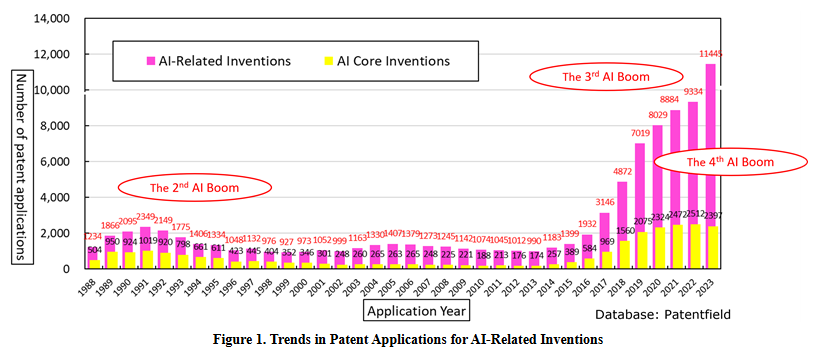
For details, see the JPO’s official publication here.
LIFE SCIENCES NEWS
PTAB Upholds Priority Win for Broad Institute in CRISPR Case
BY RICHARD KELLY
On remand from the Federal Circuit, the Patent Trial and Appeal Board (PTAB) on March 26 in Interference 106,115 again found that The Broad Institute (with MIT and Harvard) was the first to invent the use of CRISPR‑Cas9 in eukaryotic cells, reaffirming Broad’s priority over the CVC group (Regents of the University of California, University of Vienna, and Emmanuelle Charpentier).
What Changed -- and What Didn’t
- In May 2025, the CAFC vacated and remanded the PTAB’s earlier decision, holding that the Board had applied the wrong legal standard for conception by effectively requiring proof the invention was “known to work.” The CAFC clarified that conception does not require certainty of success.
- The CAFC did not disturb the PTAB’s separate finding that CVC’s 2012 provisional applications lacked adequate written description, CVC could not rely on those filings to establish constructive reduction to practice.
PTAB’s Analysis on Remand
Applying the correct conception framework, the PTAB still found that CVC failed to meet its burden as the junior party to show it conceived of an embodiment of the count before Broad reduced the invention to practice.
The PTAB emphasized a totality‑of‑the‑evidence approach, considering:- The level of ordinary skill in the art at the relevant time,
- Testimony from CVC witnesses,
- The CAFC’s written‑description ruling, and
- Evidence showing that implementing an operative eukaryotic CRISPR‑Cas9 system would have required extensive research or experimentation beyond what CVC had allegedly conceived.
Derivation Argument Rejected
The Board also rejected CVC’s derivation claim (based in part on an email), explaining that derivation requires proof of prior conception by CVC -- something the Board found CVC did not establish.
Bottom Line
Despite the CAFC’s correction of the conception standard, the outcome did not change: Broad retains priority. The decision underscores the continuing importance of robust written description and concrete evidence that an alleged conception could be carried out by a person of ordinary skill without undue experimentation.
Key Takeaways
While interferences are now as extinct as the Dodo bird, the decision has implications for obtaining benefit of earlier filed applications given it left untouched the decision denying CVC benefit of its earlier filed applications.
Although the CAFC corrected the PTAB on conception law, it affirmed the Board’s written‑description ruling against CVC’s 2012 provisional applications. Those filings were found insufficient to demonstrate possession of an operable eukaryotic CRISPR‑Cas9 system, preventing CVC from relying on them for constructive reduction to practice. The decision has a road map for the disclosure, at least the PTAB will be evaluating which parallels Amgen v. Sanofi, U.S. 594 (2023) 143 S.Ct. 1243 (2023).
The PTAB concluded that, based on the state of the art and the evidence presented, a person of ordinary skill could not have reduced CVC’s alleged conception to practice without extensive research or experimentation.
While framed as a conception analysis, this reasoning closely tracks enablement and written‑description principles.
Derivation Claims Are Effectively Dead Without Proven Prior Conception
The PTAB rejected CVC’s derivation theory outright, holding that derivation cannot be established unless the asserting party first proves prior conception of the claimed subject matter. Because CVC failed on conception, its derivation argument failed as a matter of law.
Practical Guidance for Biotech Patent Filings (Post‑Broad v. CVC)
1. Draft Provisionals as If They Will Be Litigated for Priority
The PTAB’s reaffirmed decision turned in large part on the failure of CVC’s early provisional applications to provide adequate written description of an operable eukaryotic CRISPR‑Cas9 system, which prevented reliance on those filings for constructive reduction to practice.
Going forward, treat provisionals as priority‑critical documents, not placeholders. Include concrete experimental examples (even if limited in number) as well as cell type, delivery method, expression constructs, and functional results. Avoid filing provisionals that merely describe components or hypotheses without showing operability in the claimed biological context.
Takeaway: A weak provisional can silently lose the priority contest years later, even if later non‑provisionals are strong.
2. Demonstrate Operability -- Not Just Conceptual Completeness
The PTAB emphasized that a person of ordinary skill could not have reduced CVC’s alleged conception to practice without extensive research or experimentation, undermining both conception and priority.
As practice guidance, one should explicitly show that the invention: works in the claimed environment (e.g., eukaryotic vs. prokaryotic cells), and does so without unresolved technical barriers.
Specifications should be drafted to answer the implicit question: Could a skilled artisan make this work based on what’s written here, without inventing further. This is especially important in Gene editing, Cell and gene therapy, RNA‑based technologies, and Synthetic biology platforms.
3. Use Examples Strategically -- Even Narrow Ones
The PTAB did not require dozens of working examples; rather, it focused on whether the evidence showed possession of an operable embodiment. Therefore, a small number of well‑characterized examples is often more valuable than broad, speculative disclosure.
For platform technologies include at least one fully worked embodiment, and then generalize cautiously with supporting rationale. This helps defend against later arguments that the disclosure merely “describes a research plan.”
4. Draft with “Undue Experimentation” in Mind
Although framed as a conception analysis, the PTAB’s reasoning tracked classic undue experimentation concerns, especially in unpredictable arts. Therefore, practitioners should explicitly disclose: critical parameters; known failure modes and how to avoid them; and acceptable ranges for key variables. Also, avoid language suggesting that success depends on: trial‑and‑error optimization and unknown biological interaction. The drafting mindset should be that if something is essential, spell it out -- even if it feels “obvious” to the inventors.
Also, ask does the application show actual operability, not just design? Could a POSITA practice the invention without undue experimentation? Do the inventors’ records match the level of certainty claimed?
Resources
Recent Newsletter
JANUARY 2026 - IP UPDATES
JANUARY 2026 NEWSLETTER
OCTOBER 2025 - IP UPDATES
OCTOBER 2025 NEWSLETTER
JUNE 2025 - IP UPDATES
JUNE 2025 NEWSLETTER
